Nov 10, 2025
⚗️ Today is World Science Day.
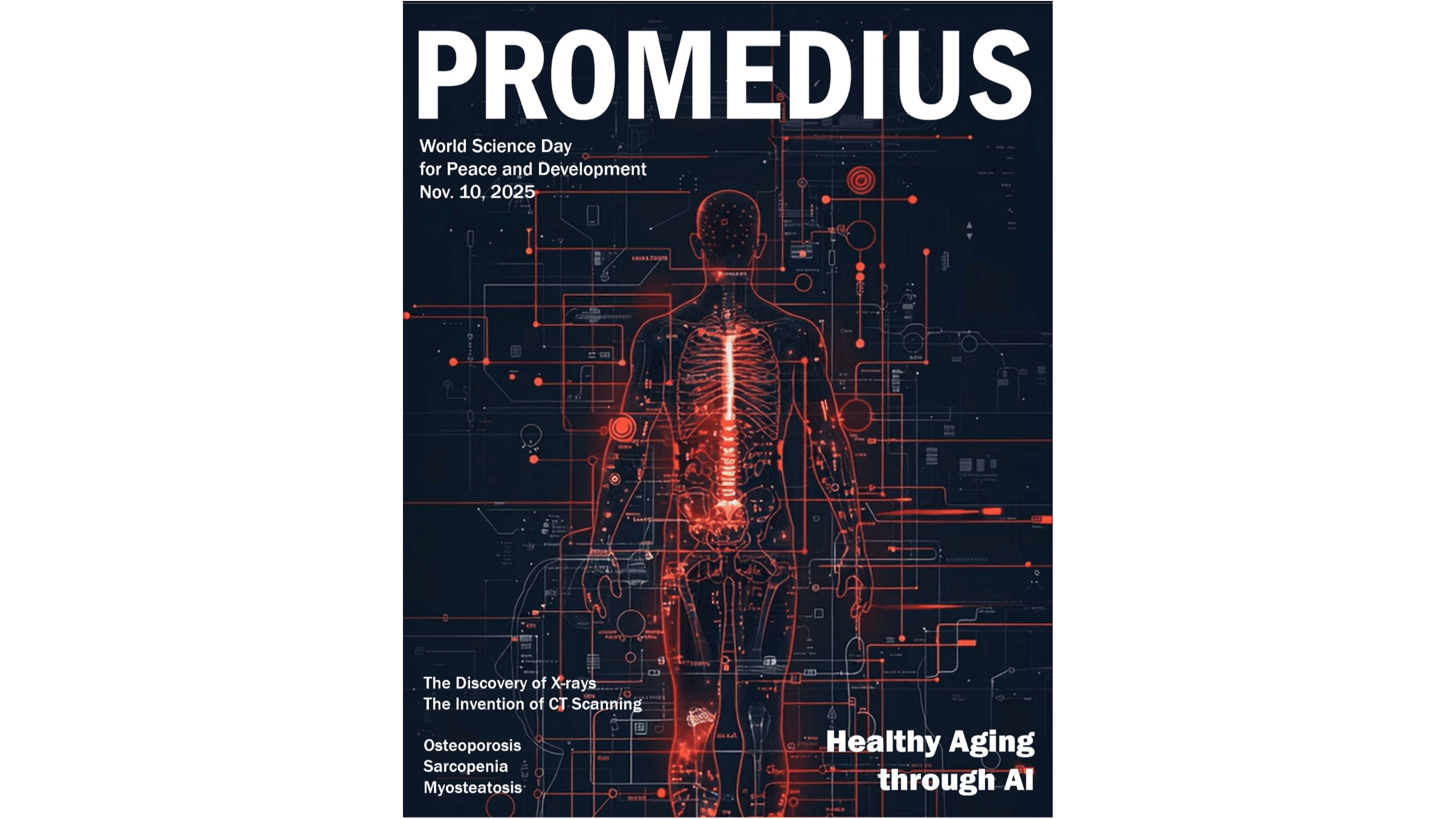
⚗️ Today is World Science Day.
The World Science Day for Peace and Development was established by UNESCO at its 31st General Conference in 2001. This day commemorates the role of science in advancing peace and human well-being, and reminds us of the need to bridge the gap between science and society.
The word science originates from the Latin term “scientia,” meaning to know. Thus, the history of science is the history of humanity learning about the unknown — a journey to understand the unseen laws of nature.
Today, we highlight two scientific milestones that have greatly influenced PROMEDIUS.
1️⃣ The Discovery of X-rays
In 1895, German physicist Wilhelm Röntgen accidentally discovered a new kind of invisible light while experimenting in his laboratory. He placed his wife’s hand on a photographic plate and captured the world’s first X-ray image.
This discovery earned Röntgen the first-ever Nobel Prize in Physics (1901) and opened humanity’s eyes to a new realm — the hidden world inside the human body.
2️⃣ The Invention of CT Scanning
Seventy-seven years later, in 1972, British engineer Godfrey Hounsfield and South African physicist Allan Cormack developed Computed Tomography (CT) — a technique that used X-rays to reconstruct three-dimensional images of the body.
This innovation ushered humanity into an era where the internal structure of the human body could be examined with unprecedented precision.
Now, humanity is expanding its vision even further — through AI.
At PROMEDIUS, we have built on the legacy of X-rays and CT by developing AI that analyzes medical images to detect early signs of osteoporosis, sarcopenia, and myosteatosis, sending new Signals to clinicians.
This marks a new chapter in the history of science — one where AI illuminates the invisible risks within the human body.
PPROMEDIUS will continue striving to fulfill our mission:
Healthy Aging through AI.
PROMEDIUS INC.
Copyright 2025 PROMEDIUS INC. All rights reserved.
13, Olympic-ro 35da-gil, Songpa-gu, Seoul, 05510 Republic of Korea

